
Weighing hardware
Find your transmitter
Six General Measure transmitters connect any load cell to any PLC, SCADA system or app. Pick the mount style that fits your installation.
Modbus RTU over RS485 is standard on every model. Network and fieldbus options are specified per transmitter at order.
Protocols across the range. Use the Fieldbus filter above to see which models support each one

PROFIBUS-DP and Bluetooth: GMT-X1 only. CANopen: GMT-X1 and GMT-X4. Modbus RTU over RS485 is standard on every model, and one network or fieldbus option is specified per transmitter at order.
Panel-mount
1 modelPick this if you need a compact indicator that drops into a panel cutout on the front of a control cabinet, with an operator display.

DIN-rail
2 modelsPick this if the transmitter clips onto 35 mm DIN rail inside the control cabinet beside the PLC. A compact OLED display handles commissioning and the weight data goes to the PLC over Modbus or your fieldbus. The usual choice for OEM machine builders.

GMT-X1 Weight Transmitter
GMT-X1
DIN-rail mount transmitter with OLED display and Bluetooth setup

GMT-X4 Weight Transmitter
GMT-X4
Four-channel DIN-rail weight transmitter with OLED
Wall-mount: stainless and field
3 modelsPick this if the transmitter mounts on a wall or desk near the scale: the stainless steel GMT-H2 and GMT-H4 for washdown food lines and harsh plant areas, or the AC-powered GMT-H1 field unit with 4G telemetry for remote silos. All three have waterproof housings.

GMT-H1 Weight Transmitter
GMT-H1
AC-powered field transmitter that reports weight data on its own, with no PLC required

GMT-H2 Weight Transmitter
GMT-H2
High-resolution DC-powered transmitter with bright LED display and fieldbus integration

GMT-H4 Weight Transmitter
GMT-H4
Four-channel stainless transmitter with OLED display and flexible fieldbus connectivity
Weighing transmitters for PLC, SCADA and OEM machines
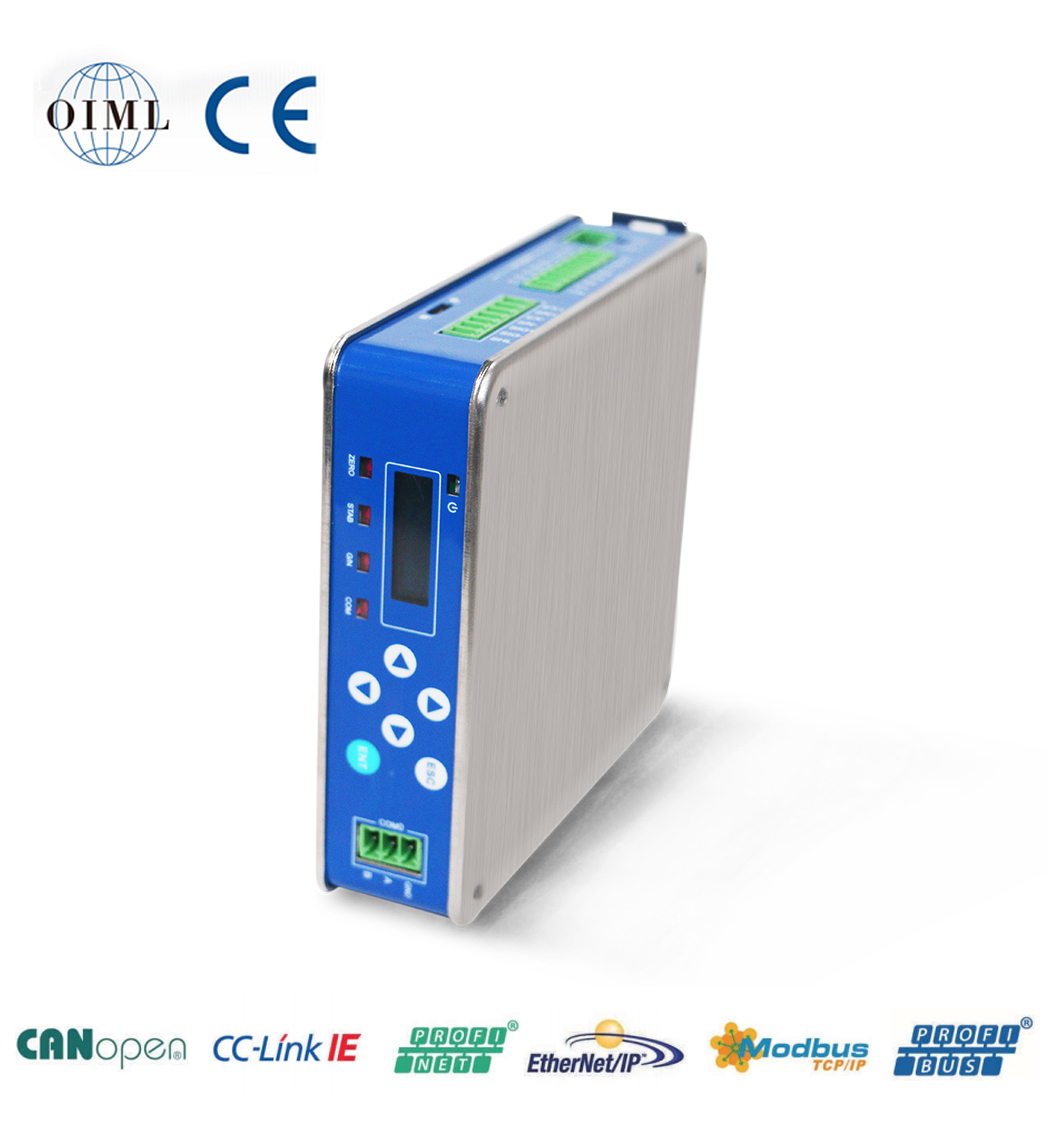
A weighing transmitter is the link between your load cells and your control system. It powers the load cell bridge, turns the millivolt signal into a calibrated weight and sends that weight to a PLC, SCADA system or HMI over Modbus or an industrial fieldbus. The right model depends on where it mounts, how many scales it reads and which protocol your PLC speaks.
R&D Weighing stocks six General Measure weighing transmitters in Centurion and supplies them across South Africa. Use the Fieldbus filter above to see which models support your protocol, then use the guide below to match a transmitter to your PLC before you ask for a quote.
Match the weighing transmitter to your PLC
- Siemens S7-1200 and S7-1500 (TIA Portal): a PROFINET weight transmitter. Choose the GMT-P1, GMT-X1, GMT-X4, GMT-H2 or GMT-H4.
- Allen-Bradley and Rockwell (Studio 5000): an EtherNet/IP weight transmitter. Choose the GMT-P1, GMT-X1, GMT-X4, GMT-H2 or GMT-H4.
- Beckhoff TwinCAT and other EtherCAT masters: an EtherCAT weighing transmitter. Choose the GMT-P1, GMT-X1, GMT-X4 or GMT-H2.
- Mitsubishi iQ-R and iQ-F: CC-Link IE Field Basic on the GMT-P1, GMT-X1, GMT-X4, GMT-H2 or GMT-H4.
- Older Siemens S7-300 and S7-400 on PROFIBUS: the GMT-X1 with PROFIBUS-DP keeps the plant running without a controls upgrade.
- CANopen machine controllers: the GMT-X1 or the four-channel GMT-X4.
- Any PLC, SCADA or IIoT platform: Modbus TCP is available on all six models, and Modbus RTU over RS485 is standard.
- Remote silos with no PLC on site: the AC-powered GMT-H1, or the GMT-H4, with 4G / GPRS telemetry that stores unsent records and resends them when the signal returns.
One network or fieldbus option is fitted per transmitter and specified at order. Modbus RTU over RS485 is standard on every model.
Siemens, Allen-Bradley, Rockwell, Beckhoff and Mitsubishi are trademarks of their respective owners and are named only to show compatibility. R&D Weighing is not affiliated with or endorsed by them.
For OEMs and machine builders
The DIN-rail GMT-X1 and GMT-X4 clip onto 35 mm rail beside the PLC, so a weighing channel is just another module in the cabinet. Specify the fieldbus once and the same transmitter goes into every machine you build. We supply OEM volume pricing, hold stock in Centurion and help your controls engineer get the transmitter talking to the PLC on the first machine.
Load cells, controllers and the complete weighing chain
A transmitter is one part of the weighing chain. It is paired with load cells sized to the application and, depending on the architecture, either sends weight straight into the PLC or feeds a weighing controller for automated batching, packing or filling. We help you specify the load cell, transmitter, controller and protocol together at quote stage so the system works from day one.