
GMT-H1 Weight Transmitter
Quick specs
| Approval & Accuracy | |
|---|---|
| Excitation Voltage | DC 5 V, 200 mA (max); 1 analog channel, up to 8 × 350 Ω load cells |
| Signal Input Range | 0.00 – 15 mV (3 mV/V load cell) |
| Connectivity | |
| Digital I/O | 3 in / 3 out fixed + 3-way user-configurable I/O |
| Serial Comms | 1× RS485 (Modbus RTU) |
| Physical & Environment | |
| Display | LCD screen + 4-key tactile keyboard |
| Housing | ABS waterproof suspension shell |
| IP Rating | Waterproof enclosure (no IP rating stated) |
| Mount | Wall hanging, 175 × 150 × 75 mm |
| Power Supply | AC 90 – 260 V, 50 / 60 Hz ±2%; ~10 W; 750 g |
| Operating Temperature | -10 ℃ to +40 ℃ (certified) |
| Operating Humidity | ≤90% RH, non-condensing |
Applications
Applications
Built for sites that need weight data reported back without a control system on site. The H1 logs and transmits its own readings, in/out material records and batch totals over cellular, making it suited to remote and unmanned installations.
- Remote tank and silo level
- Field vessel weighing
- Off-grid mining and quarry sites
- Agricultural silos and feed bins
- Water and chemical dosing stations
- Rural depot and storage telemetry
- Material-level (filling) systems
- IoT and SCADA backhaul over cellular
OEM & ODM ready
Built for integration into your line, your machine, or your brand.
As General Measure’s South African partner, R&D Weighing supports OEM and ODM engagements across the transmitter range. From private-label badging through to custom enclosures, communication protocols, and full system integration with your existing PLC, MES, or ERP environment.
- Private-label finishing & branding
- Custom enclosure & mounting options
- PLC / MES / ERP integration
- Bespoke communication / protocol configurations
- Multi-channel synchronisation
- Engineering support throughout commissioning
Compliance & quality
CE compliant
IP65 rated
The GMT-H1 weight transmitter is an AC-mains field-mount weighing instrument built for sites where 24 VDC infrastructure does not exist and remote telemetry matters. It runs directly off AC 90-260 V (50/60 Hz), includes a built-in GPRS/4G communication module for cellular data backhaul, and combines RS485 Modbus-RTU, an RJ45 Modbus-TCP network port and on-board material (filling) functions in a 175 x 150 x 75 mm sealed waterproof suspension housing - ideal for remote silos, off-grid mining sites and rural agricultural depots across Southern Africa.
AC-mains powered - the one that does not need 24 VDC
Every other transmitter in the General Measure range runs on DC 24 V. The GMT-H1 is the exception: it accepts AC 90-260 V at 50 or 60 Hz directly, with no external power supply needed. That single feature changes where it can be installed. Rural silos, water-treatment storage, agricultural feed bins, remote mining stockpiles and standalone weigh-rooms typically have AC mains available but no 24 VDC bus and no PLC cabinet - the H1 wires straight into the local plug-point or distribution board and works.
The waterproof sealed suspension shell with cable glands handles outdoor and washdown duty. At 750 g the unit hangs from a single wall bracket, with the LCD screen, four-key keypad and status LEDs (POWER, STABLE, COMx, GPRS) visible to operators at the site.
GPRS cellular telemetry built in
The GMT-H1 has a GPRS communication module built into the standard configuration, not as an after-market add-on. With a SIM card and basic APN setup, it pushes weight data, in-out material records and historical batches to a remote SCADA or IoT platform over the cellular network - useful when the site has no Ethernet or Wi-Fi but does have mobile-network coverage. The MAC auto-send protocol fires structured frames on weight stability or on schedule, so the central system can build trend data without polling.
For sites with existing infrastructure, the H1 also supports Modbus RTU over RS485 and Modbus TCP over the built-in RJ45 Ethernet port - giving traditional PLC or SCADA integration the same way as the rest of the range.
Material-level (filling) functions
Beyond pure weight transmission the H1 includes a material-level filling function with three coarse-medium-fine fill modes, history data logging (in-bound, out-bound and batch records) and 3 + 3-way digital I/O with one variable IO that can be defined as input or output. That makes it not just a transmitter but a small standalone filling controller for single-vessel, single-product duties - silo top-up, day-tank dosing, vehicle loading at a depot - without needing a separate batching controller in the loop.
For sites that already have a controller and just need a sensor-and-telemetry unit, those filling functions stay dormant and the unit acts as a pure remote-weight transmitter.
Frequently asked questions
Is the GMT-H1 really AC-powered?
Yes. AC 90 – 260 V at 50 or 60 Hz ±2% - it wires directly into mains power without a 24 VDC supply.
How does the GPRS module work?
You insert a standard SIM card (any local carrier that offers data) and configure the APN through the front panel or the Modbus connection. The H1 then pushes data over GPRS to a server you specify typically a SCADA, MQTT broker or simple TCP listener. The MAC auto-send protocol formats the frames; sample IoT integration code is in the user manual.
Can the GMT-H1 run as a small batching controller?
For single-product filling - silo top-up, day-tank dosing, vehicle loading - yes. The built-in material-level filling function supports coarse / medium / fine cutoff phases plus history logging. For multi-recipe or multi-material batching with weighed-in ingredients, step up to a dedicated controller like the GM9907-LB.
How many load cells does it support?
One analog channel, up to 8 × 350 Ω load cells in parallel through a 6-wire (preferred) or 4-wire connection. Same sensitivity options (1, 2 or 3 mV/V) as the rest of the range.
What is the difference between the GMT-H1 and GMT-H2?
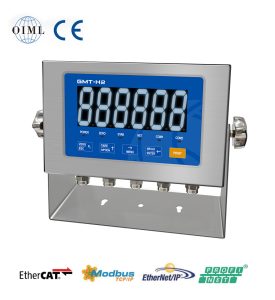
Both are stainless wall-mount transmitters with similar load-cell architecture. The H1 is AC-powered with a built-in GPRS telemetry module and an LCD display - built for remote, off-grid duty. The H2 is DC 24 V powered with a brighter 2" 6-digit LED display and more on-cabinet fieldbus options (Profinet, EthIP, EtherCAT) - built for in-plant washdown duty.