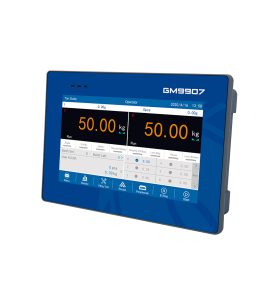
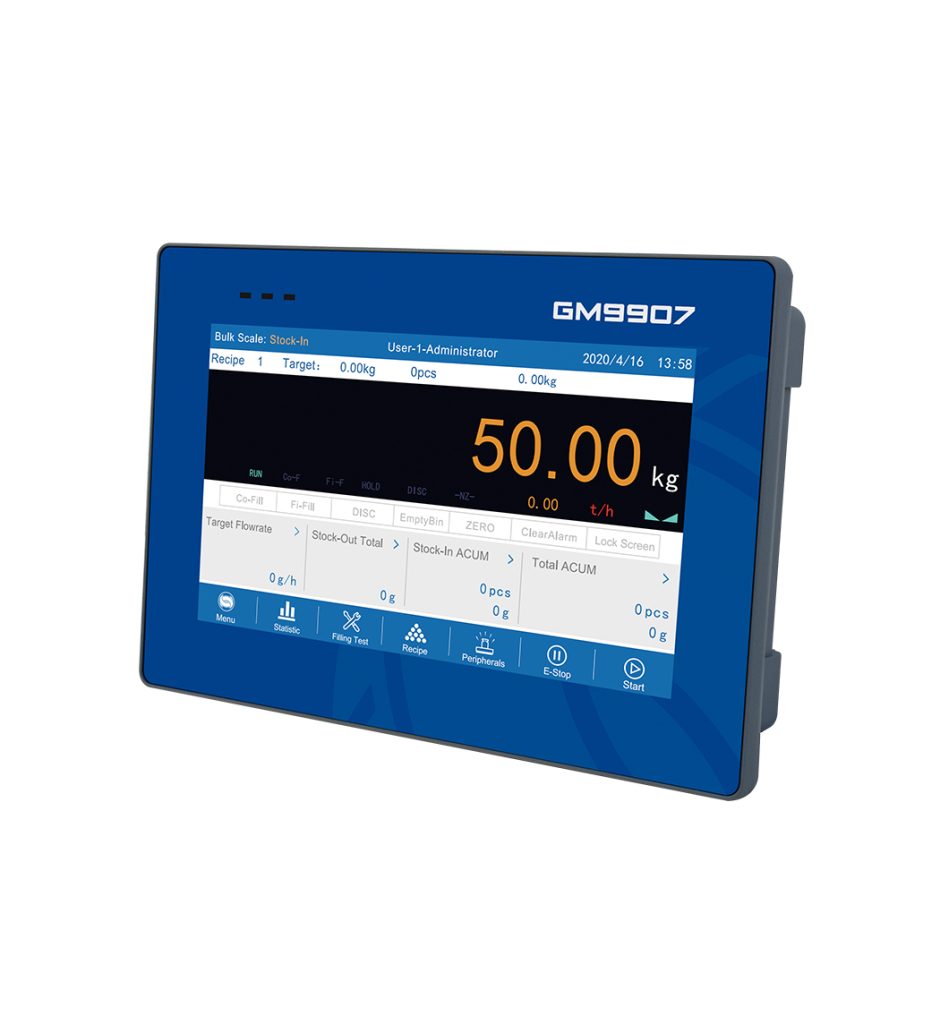
GM9907-L5 Continuous Bulk Scale Controller
Quick specs
| I/O & Performance | |
|---|---|
| Inputs | 12 digital inputs, opto-isolated, low-level effective |
| Outputs | 16 digital outputs, open-collector, 500 mA driving / 3 A full load |
| Communication | RS-232 (TXD/RXD/GND) and RS-485 (A/B/GND), MODBUS-RTU, MODBUS-TCP, USB port |
| A/D speed | 24-bit Sigma-Delta, 120 / 240 / 480 / 960 conversions per second |
| Resolution | 1 / 100,000 (max display); input sensitivity 0.02 µV/d |
| Connection | |
| Display | 7-inch resistive touch screen, English |
| Load cell excitation | DC 5 V, 125 mA max (supports 6-wire load cells) |
| Physical & Environment | |
| Power supply | DC 24 V, ~15 W (power filter included) |
| Operating temperature | -10 ℃ to +40 ℃ |
| Operating humidity | ≤90% RH, non-condensing |
| Enclosure | Panel-mount; cut-out 180 × 114 mm (+1 mm tolerance), fixed via M3×10 screws on side plates |
| Dimensions | 199 × 133 × 46.7 mm (W × H × D) |
Applications
- OEM Process Scales
- Grain & Feed Throughput
- Fertilizer Bulk Throughput
VARIANTS
Continuous weighing for inbound and outbound bulk flows
A bulk scale doesn’t fill bags; it continuously weighs material moving through a vessel. The GM9907-L5 handles the cycle: open the inlet, weigh the batch in the hopper, close the inlet, discharge to the downstream conveyor, repeat. Over many cycles it builds an accurate cumulative total of material moved, which becomes your stock figure for inbound receipts or outbound dispatch.
Key bulk scale capabilities
| Feature | GM9907-L5 |
|---|---|
| Operating modes | Stock-In (receipt totalisation) or Stock-Out (dispatch totalisation) |
| Feed & discharge | Pneumatic or motor-driven feed gate; pneumatic, single-limit, double-limit, or rotary-motor discharge |
| Flow monitoring | Low-flow alarm with feed and discharge overtime protection |
| Totalisation | Total accumulation, plus per-recipe (×20) and per-operator (×10) totals |
| I/O | 12 inputs / 16 outputs, opto-isolated |
| Communication | RS-232, RS-485 (Modbus RTU), Ethernet (Modbus TCP), USB for data export |
How it fits in a bulk handling operation
Grain, feed and process applications: totalise material moving between silos, into trucks, or onto export conveyors. An ideal replacement for an ageing bulk weigher. The built-in Modbus TCP interface pushes live totals into plant SCADA and ERP for stock reconciliation, without needing a separate gateway.
OEM & ODM ready
Built for integration into your line, your machine, or your brand.
As General Measure’s South African partner, R&D Weighing supports OEM and ODM engagements across the controller range. From private-label badging through to custom enclosures, communication protocols, and full system integration with your existing PLC, MES, or ERP environment.
- Private-label finishing & branding
- Custom enclosure & mounting options
- PLC / MES / ERP integration
- Bespoke communication / protocol configurations
- Multi-line synchronisation
- Engineering support throughout commissioning
The bulk scale controller GM9907-L5 totalises stock-in and stock-out across the working day, tracking inventory as material flows through belt scales, weighbridges, intake hoppers and discharge stations. The L5 is the standard choice for South African ports, grain handling operations, cement plants, fertiliser depots and any bulk-handling site where daily reconciliation between trucks-in, stockpile and trucks-out matters for inventory accounting.
Continuous totalisation for bulk inventory
Where a packing or batching controller manages discrete fixed-weight cycles, a bulk scale controller manages continuous flow. The GM9907-L5 keeps separate stock-in and stock-out totals, shift totals, daily totals and resettable batch totals. So a harbour grain terminal can know exactly how much wheat moved from ship to silo in the night shift, and how much moved from silo to truck during the day. The L5 also supports multi-product totalisation, so a cement depot moving four product grades can keep separate inventory counts per product.
Integration with hopper scales and process lines
The GM9907-L5 is built around a weighing hopper with coarse and fine feed inputs and a discharge output, so it slots directly into bulk process lines: silo loading, reactor charging, mixer feeds, blending stations and intake/dispatch hoppers under conveyors. Two relay-driven feed stages and a discharge output handle the mechanical side, while Modbus RTU over RS-485, Modbus ASCII over RS-232 and Modbus TCP over Ethernet feed live weights, totals and recipe data to the supervisory PLC or SCADA. Dual serial ports also drive a ticket printer and a secondary display in parallel, so operators on the floor see the same totals as the control room.
Frequently asked questions
What is the difference between a bulk scale controller and a batching controller?
Where a packing or batching controller manages discrete fixed-weight cycles, the GM9907-L5 manages a continuous accumulation hopper, repeatedly filling, weighing and discharging to total bulk throughput. It keeps separate stock-in and stock-out totals plus resettable batch totals, so a silo intake hopper can log exactly how much material was received from rail or truck deliveries, and how much was drawn off to production. With 20 recipes on board, a site handling several product grades can keep separate inventory counts per product.
Can the GM9907-L5 connect to a existing process scale?
Yes. The GM9907-L5 accepts the standard load cells used on your existing scale, and its built-in I/Os to drive the rest of the control gear directly. It's the standard controller specified for bulk stock totalisation, with separate stock-in and stock-out modes for inventory reconciliation.
Does the L5 support multiple product types on one scale?
Yes. The L5 stores up to 20 recipes, each with its own target and its own accumulated weight and count. Switching recipe on the panel (or remotely via Modbus) routes the totals into that product's register, so a depot handling, say, three fertiliser grades or several seed grades on one line can reconcile stock per grade rather than as an aggregate..