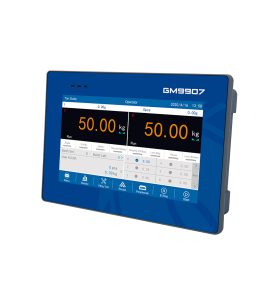

GM9907-L4 Reduced Weight Controller
Quick specs
| I/O & Performance | |
|---|---|
| Inputs | 12 digital inputs, opto-isolated, low-level effective |
| Outputs | 16 digital outputs, open-collector, 500 mA driving / 3 A full load |
| Communication | RS-232 (TXD/RXD/GND) and RS-485 (A/B/GND), MODBUS-RTU, MODBUS-TCP, USB port |
| A/D speed | 24-bit Sigma-Delta, 120 / 240 / 480 / 960 conversions per second |
| Resolution | 1 / 100,000 (max display); input sensitivity 0.02 µV/d |
| Connection | |
| Display | 7-inch resistive touch screen, English |
| Load cell excitation | DC 5 V, 125 mA max (supports 6-wire load cells) |
| Physical & Environment | |
| Power supply | DC 24 V, ~15 W (power filter included) |
| Operating temperature | -10 ℃ to +40 ℃ |
| Operating humidity | ≤90% RH, non-condensing |
| Enclosure | Panel-mount; cut-out 180 × 114 mm (+1 mm tolerance), fixed via M3×10 screws on side plates |
| Dimensions | 199 × 133 × 46.7 mm (W × H × D) |
Applications
- Silo Discharge & Bagging
- Drum & IBC Filling from Bulk Tanks
- Reactor & Mixer Charge Dosing
- Continuous-Feeder Refill Control
- Rice, Grain, Flour & Feed Discharge
VARIANTS
What is the Reduced Weight Method?
The Reduced Weight Method (also known internationally as loss-in-weight) measures the weight a supply vessel loses as material discharges out of it. The vessel itself sits on load cells and acts as the scale. The controller watches the weight decrease in real time, switches between coarse and fine flow, and closes the discharge valve when exactly the target quantity has been delivered.
This is fundamentally different from gain-in-weight measurement (used by packing controllers like the GM9907-L2 / LD), where an empty weigh hopper sits below the supply and material is weighed as it falls in. The Reduced Weight method skips that intermediate weigh hopper entirely.
Why specify the Reduced Weight Method?
| Benefit | What it solves |
|---|---|
| No intermediate weigh hopper | Saves headroom, capex, footprint and a second cleaning point. Material flows in a single continuous path from supply to delivery. |
| Better for difficult materials | Sticky, hygroscopic, bridging or fluidising powders cause hang-ups in a separate weigh hopper. Keeping the material in the supply vessel reduces this. |
| Works with continuous feeders | Screw feeders, vibratory feeders and rotary valves integrate naturally with the L4 because the controller is watching the supply, not a weigh vessel. |
| Single supply vessel design | One vessel does the job of two: supply storage and weighing. Cleaner process design. |
Controller capabilities
| Feature | GM9907-L4 |
|---|---|
| Measurement method | Reduced Weight (also called loss-in-weight) |
| Recipe storage | 20 recipe groups + 9 user accumulation data sets |
| Data backup & recovery | Automatic parameter save for power-loss recovery |
| Scale configuration | Single or double scale, switchable |
| Flow control | Coarse / fine flow, programmable I/O |
| I/O | 12 inputs / 16 outputs, opto-isolated |
| Communication | RS-232, RS-485, MODBUS-RTU, MODBUS-TCP, USB |
| Display | 7-inch resistive touch screen |
Typical applications
Silo discharge bagging: rice, grain and feed mills bagging finished product directly from cooling and storage silos. Drum and IBC filling from bulk tanks: chemical, lubricant and food-grade tank discharge into shipping containers. Reactor / mixer charge dosing: dispensing a known weight of raw material into a batch process from a supply vessel. Continuous-feeder refill control: managing a buffer hopper that feeds a downstream extruder, mixer or process line.
The Modbus-TCP interface integrates batch records, dose counts and weight totals into plant SCADA or ERP systems for traceability.
OEM & ODM ready
Built for integration into your line, your machine, or your brand.
As General Measure’s South African partner, R&D Weighing supports OEM and ODM engagements across the controller range. From private-label badging through to custom enclosures, communication protocols, and full system integration with your existing PLC, MES, or ERP environment.
- Private-label finishing & branding
- Custom enclosure & mounting options
- PLC / MES / ERP integration
- Bespoke communication / protocol configurations
- Multi-line synchronisation
- Engineering support throughout commissioning
The reduced weight controller GM9907-L4 measures material discharged from a supply vessel by tracking the vessel's own weight loss during dispensing. The silo, day-bin or bulk hopper itself becomes the scale. This approach is the right fit for friable materials that would degrade in a conventional belt scale, for sticky or hygroscopic ingredients that bridge in intake hoppers, and for any application where an intermediate weigh hopper is impractical due to headroom, footprint or hygiene constraints.
How reduced-weight (loss-in-weight) measurement works
A reduced-weight controller continuously samples the load cell signal on the supply vessel and integrates the rate of weight loss over time. The controller knows that whatever weight has left the vessel has been dispensed, so the rate of weight reduction gives the instantaneous flow rate and the cumulative loss gives the dispensed total. This is fundamentally more accurate than belt-scale measurement for friable, sticky or low-density materials that do not present a consistent profile to a belt-mounted load cell.
Typical applications
Reduced-weight measurement is the default choice for: silo-mounted discharge into mixing or batching plants where a separate weigh hopper would add headroom requirements; pharmaceutical and food powders where hygienic clean-out matters more than absolute speed; chemical and mineral feed into reactors where the supply vessel needs accurate stock-tracking; and fragile granular materials (extruded feed, coated seed, brittle aggregate) where a belt scale would crush product.
Frequently asked questions
When should I choose a reduced weight controller instead of a belt scale?
Choose reduced-weight (loss-in-weight) measurement when the material is friable, sticky, hygroscopic, fragile or so light/low-density that a belt scale gives unreliable readings. Choose a belt scale when material flow is continuous over hours, the material is robust, and headroom for a supply vessel above the scale is not available.
Does the GM9907-L4 need a separate weigh hopper?
No. That is the whole point of the reduced-weight architecture. The supply vessel itself sits on load cells and becomes the scale. This eliminates the headroom, footprint and clean-down cost of an intermediate weigh hopper, which is why the L4 is the preferred choice for retrofits where headroom is constrained.
Can the GM9907-L4 control the discharge rate?
Yes. The controller can drive a variable-speed screw feeder, vibratory feeder or modulating valve to maintain a setpoint discharge rate, making it a gravimetric metering controller, not just a measurement device. This is the configuration used for continuous feed into mixers, reactors and dosing systems.